

The Semiquincentennial Choice
Human Dignity, Foucault, and the Culture of Suspicion

By Mark Strand
On July 4, 2026, Americans will once again gather under banners and beside monuments to celebrate the 250th anniversary of the Declaration of Independence. We will hear the familiar words recited from courthouse steps and Capitol balconies: “We hold these truths to be self‑evident, that all men are created equal, that they are endowed by their Creator with certain unalienable Rights…” We have repeated that sentence so often that it risks becoming background noise. Yet embedded in its brief lines is an entire vision of the human person—and it is not the vision that dominates many of our universities today.
The statesmen of 1776 spoke in a vocabulary that assumed there were such things as human nature, human dignity, and human rights, and that these realities were not inventions of politics but the very standard by which politics would be judged. As we mark the Semiquincentennial, the question is not only whether we still admire the Founders’ courage or approve their particular policies. The question is whether we still believe what they said about what a human being is. On that answer hangs far more than an anniversary speech.

The famous sentence from the Declaration is easily memorized, but it is worth slowing down long enough to see what it presupposes. “We hold these truths to be self‑evident, that all men are created equal…” The word “created” does enormous work here. The men in Philadelphia did not think of human beings as self‑invented wills floating free of any given nature. To be created is to have a nature you did not choose, to receive your existence and your basic powers as a gift. It is also to stand in relation to a Creator who is prior to every state and superior to every legislature.
They go on to say that all men “are endowed by their Creator with certain unalienable Rights.” Rights, in this account, are not permissions granted by government or favors conferred by a majority. They are rooted in the way human beings actually are. Because a human person is a certain kind of being—a rational creature capable of deliberation, love, and responsibility—certain things are “due to” that person as a matter of justice. Government’s role is not to manufacture those rights, but to recognize and secure them.
Finally, the sentence claims that these truths are “self‑evident.” The Founders did not mean by this that every individual in every age will spontaneously affirm them. They meant that, upon due reflection, human reason can genuinely see certain moral facts about the human person—that it is wrong to treat persons as mere things, that it is unjust to deny them equal standing before the law—and that these facts do not depend on the preferences of the powerful. The Declaration is, among other things, a public act of confidence in our capacity to know at least this much about ourselves.
A republic built on this sentence assumes a great deal: that there is a human nature, that there is a real dignity grounded in that nature, and that we can know enough about both to bind even kings and parliaments. As we celebrate 250 years of independence, the uncomfortable fact is that much of our intellectual culture no longer shares those assumptions. That is the collision we now face.
Bishop Robert Barron has recently described this as an “anthropological crisis” within the university: a clash between a classical vision of the human person, ordered to truth, capable of wonder, made in the image of God, and what he calls a “pessimistic anthropology” drawn from Marx, Nietzsche, Sartre, and Foucault. In his 2026 Neuhaus Lecture, ‘Recovering the University’s Soul,’ delivered under First Things’ auspices, Barron argues that students are now trained to approach texts and traditions not to see what truth they might disclose, but chiefly to ask whose interests they serve and what structures of domination they reinforce. My argument is that this same anthropology of suspicion now shapes not only the campus but the broader American elite—and it stands in profound tension with the account of the human person we commemorate every Fourth of July.
Two anthropologies: dignity vs suspicion
At 250, the United States finds itself living on the moral capital of an anthropology it no longer quite believes. The Declaration tells us that “all men are created equal” and “endowed by their Creator with certain unalienable Rights,” including life and liberty. Implicit is a claim about what freedom is for: men and women are free not as isolated wills, but as creatures capable of recognizing the truth about themselves and ordering their lives to it. The Founders debated the content of virtue, but they did not imagine a liberty detached from moral purpose.
Over two centuries later, Pope John Paul II, speaking from a very different institutional podium, said much the same thing in a more explicitly theological idiom. God gives man freedom, he insisted, so that he may be free to do what he ought, free for truth, for love, for the “sincere gift of self” that gives human life its deepest meaning. In his social teaching, there “exists something that is due to man because he is man, by reason of his lofty dignity,” and both politics and culture are to be judged by whether they respect that dignity and foster that freedom.
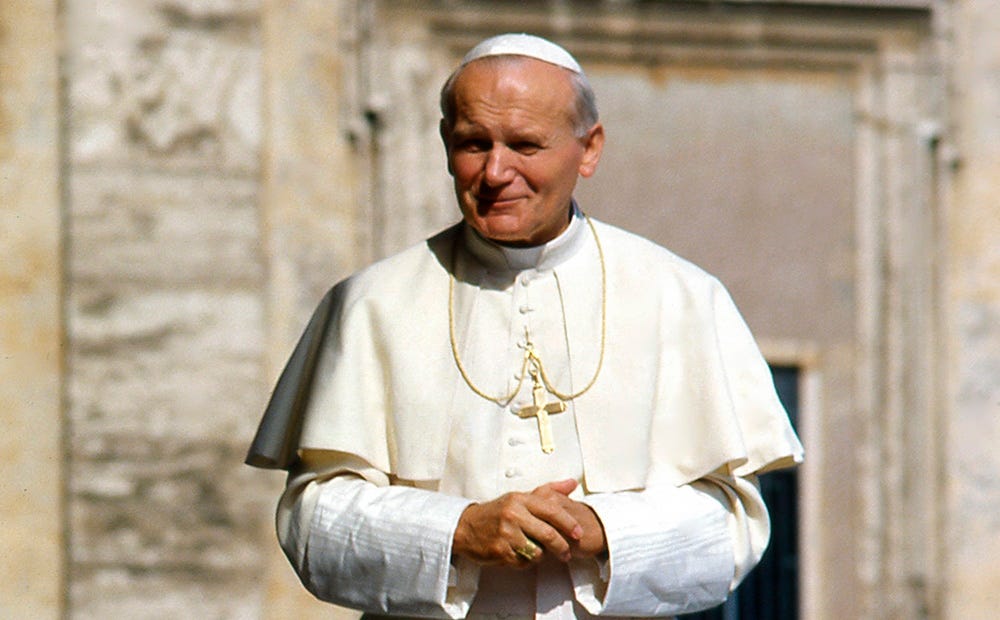
Set against this, the Foucauldian “culture of suspicion” now ascendant in much of the social sciences offers a very different picture. The human subject is no longer a creature with a given nature and vocation, but an “invention of recent date” produced by shifting regimes of power/knowledge, destined perhaps to be “erased, like a face drawn in sand at the edge of the sea.” Freedom, in this frame, is not ordered to what we ought to do, because there is no stable “ought,” only the perpetual contest of discourses. Dignity and duty become, at best, rhetorical tools within that contest. The question the Semiquincentennial forces upon us is whether a republic founded on the first anthropology can endure if it educates its future elites in the second.
Can the philosophy of the Founders in 1776 compete with the philosophy of the university in 2026? Let’s look at what is being taught.
Vignette 1: The Declaration in a sociology seminar
It is the week before July 4th in a sophomore sociology seminar. The syllabus assigns the Declaration of Independence, not as a founding charter to be understood on its own terms, but as an artifact in a unit called “Texts of Hegemony.” The professor projects the familiar sentence on the screen—“We hold these truths to be self‑evident, that all men are created equal…”—and immediately asks the class: “Whose interests are served by calling these truths ‘self‑evident’?”
A student ventures that the claim might be true, or at least that the idea of equal dignity has inspired abolitionists and civil‑rights leaders. The professor nods politely, but steers back to the preferred framework: “Notice that ‘men’ here means white, property‑owning males. ‘Self‑evident truths’ is the language a dominant group uses to naturalize its own power and make it appear beyond question.”
No one denies the historical exclusions; they are real and grave. But the only acceptable vocabulary in the room is that of power and exclusion. No one is encouraged to ask whether the proposition itself—that all human beings are created equal and endowed with unalienable rights—might be true and might therefore stand in judgment over the very men who first penned it. The anthropology of 1776—the idea that there are truths about the human person that bind rulers and ruled alike—never gets a hearing. In its place, students internalize a quieter lesson: language about dignity and rights is strategic at best, a mask for domination at worst.
Vignette 2: A social‑theory colloquium on “love”
Across campus, a small graduate colloquium in social theory is reading Michel Foucault and contemporary critical theorists on power and subjectivity. The topic for the week is ostensibly “Love and Care in Late Modernity.” A student proposes that perhaps, even in complex institutions, some people really do act from love: a nurse staying past her shift, a social worker going the extra mile for a client.
The seminar pauses, and then the familiar machinery starts to hum. Another student responds that what we call “love” in these settings is “a technology of normalization”—a way organizations secure compliance by inducing workers to internalize their roles. The professor affirms this insight, linking it to Foucault’s analysis of pastoral power: modern institutions “care” for us in order to shape us, to produce certain kinds of subjects.
Soon, every example of concrete concern for another person is redescribed in terms of biopolitics and discipline. The nurse’s sacrifice becomes a symptom of gendered labor norms; the social worker’s devotion is folded into the logic of the welfare state. No one denies that these structures matter; they clearly do. But there is no conceptual room left to say, without irony, “This person has a dignity that calls forth my love,” or, “I am free to do what I ought for their good.”
The students leave with sharpened suspicion and depleted hope. They are highly trained to unmask power, but poorly equipped to affirm the worth of the persons for whose sake they might one day wish to act. In such a classroom, the very words that animated the Founders and John Paul II—truth, dignity, love—have become, in effect, philosophically embarrassing.
How Foucault undercuts dignity
At the core of Michel Foucault’s project is the claim that what we take to be “truth,” “knowledge,” and even “the subject” are products of power relations and historically specific “regimes of truth.” Knowledge does not stand outside power as a neutral access to reality; power and knowledge are mutually constitutive, determining what can be said, who may speak, and what counts as true. The modern human subject, on this account, is not an enduring, unified self with intrinsic dignity, but the outcome of disciplinary mechanisms—surveillance, normalization, categorization—that shape how people understand and regulate themselves.
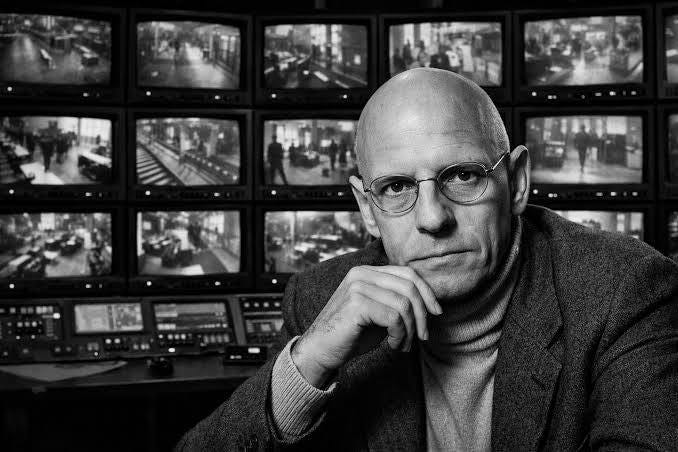
This is why Foucault is often grouped with “anti‑humanism.” He explicitly rejects the Enlightenment-style humanist picture of man as a stable, rational, autonomous center of meaning and value. Modern “man,” as he puts it, is a discursive construct, a recent invention that may one day disappear “like a face drawn in sand at the edge of the sea.” In that frame, there is no given human nature to ground inviolable dignity, no vantage point “outside” regimes of power from which one could affirm the equal worth of all persons in the strong sense you find in the Founders or John Paul II.
The depressing spiral
If you are a student or professor who genuinely internalizes this view, you are almost compelled to think of yourself as an “intellectual slave” to cultures and discourses you did not choose. You are constituted by power; the very categories through which you think—normal/abnormal, sane/insane, citizen/deviant—are themselves products of disciplinary regimes. You can map and critique those regimes, but you do not get to step outside them as a free, rational subject possessing a dignity that transcends them.
Foucault often describes power as “productive, not just repressive,” emphasizing that it creates subjects, identities, and possibilities, not only constraints. Advocates will say this opens space for resistance, irony, and tactical reversal. But there is a cost, an unmistakable psychological and moral spiral:
· If every appeal to truth or human nature is just another “regime of truth,” then your own moral intuitions about the equal worth of persons become suspect from the start.
· If your loves and loyalties are read mainly as effects of power, you are discouraged from trusting them as starting points for action on behalf of the common good.
· If “man” is a contingent construct with no stable essence, then talk of a universal human dignity or vocation to truth and love looks not just wrong but naïve or oppressive.
And we wonder why so many young people are depressed. You are trained to turn the acid of suspicion on every motive—including your own—to such a degree that genuine commitment to the good of “the whole” becomes almost unintelligible.
Love, truth, and the “abhorrence” of humanism
The older concept of human dignity—whether in the Founders’ natural-rights language or John Paul II’s personalism—presupposes that human beings are ordered to truth, beauty, and love, and that it is fitting to strive to serve humankind through them. To love my neighbor in that tradition is precisely to affirm:
You are more than your social location or your function in a system.
You possess a worth that commands my respect and can call my own community and institutions to account.
I can and should act on that truth, however imperfectly, for your good.
Anti‑humanist strands of postmodernism turn that impulse into something “monstrous.” One postmodern critic of liberal humanism describes it as a machinery that dupes “subjects” with the illusion of free will into oppressive social systems; humanist talk of value, dignity, and autonomy is treated as part of the ideological apparatus. Other postmodern‑friendly humanists explicitly argue that we must give up on “fixed human nature” and “ultimate rationality” as foundations, and rest content with our preferences for a democratic, caring society without deeper justification.
If love itself is redescribed primarily as a technique of normalization, a way institutions induce subjects to internalize discipline, then of course the very concept becomes suspect. To say “I love mankind” or “I love my students” risks sounding, in Foucauldian ears, like “I am participating in a regime that produces certain compliant subjects.” That is a philosophical abhorrence: love and care are no longer seen first as responses to the real dignity of others, but as moves in a game of power.
That is not just intellectually mistaken but spiritually dangerous. It disconnects the will to love from any secure conviction about who or what is lovable, and why.
Two philosophies on a collision course
On one side is the founding view:
Human beings are created with a real nature and endowed with dignity, prior to the state and not conferred by it.
Reason can grasp at least some basic truths about that nature— “self‑evident” truths about equality and rights—that bind rulers and ruled.
Freedom is ordered to what we ought to do: to seek truth, to practice justice, to make a “sincere gift of self” in love.
This picture underwrites both the Declaration’s language of rights and John Paul II’s insistence that there is “something that is due to man because he is man, by reason of his lofty dignity.” It gives citizens reasons to act for the common good.
On the other side is the Foucauldian “culture of suspicion”:
“Man” is not a stable kind but “an invention of recent date,” a figure produced by regimes of power/knowledge that may be erased.
Claims about truth, nature, dignity, or rights are read primarily as effects of power—moves within a struggle, not answers to a reality that stands over us.
Freedom is reconceived as resistance to normalization, not as a capacity to conform oneself to what one ought to do, because there is no stable “ought,” only shifting discourses.
Once this outlook becomes the implicit creed of the social sciences and humanities, it trains future lawyers, teachers, journalists, and policymakers to hear the founding language of equal, God‑given dignity not as a serious description of what humans are, but as a historically situated “hegemonic discourse.”
Real-world consequences of which wins
We are on a collision course: the grammar of 1776 and the grammar of Foucault cannot both govern our public life. Here are three areas where the conflict will be obvious:
Law and rights: If rights are no longer grounded in a real human nature but in negotiated discourses, then courts and legislatures will increasingly treat them as adjustable, contingent arrangements. The phrase “unalienable rights” becomes nostalgia rather than a constraint. We already see judges and commentators arguing that sociological and cultural background so mitigates responsibility that even grave crimes are treated more as symptoms than as acts.
Bioethics and the vulnerable: If the most intellectually sophisticated accounts of the person are suspicious of nature and universals, it becomes harder to defend the equal worth of the very young, the disabled, or the dying—the people John Paul II calls the first victims of a “culture of death.” We see it in Canada’s rapidly expanding MAID regime and in Iceland’s near disappearance of children born with Down syndrome—policies defended as progress, but intelligible only if some lives are judged less worth living.
Civic motivation: A culture that tells its elites that “truth” and “love” are mainly masks for power will produce bright cynics, not citizens eager to “secure these rights” for others at cost to themselves. The habit of unmasking slowly eats away at the will to build. It also reduces the desire for relationships and community—as seen in declining marriage rates, falling birthrates, and an epidemic of loneliness in the middle of large populations.
The classroom vignettes above are miniature laboratories where this collision is already visible: students are explicitly taught either to see “created equal” as a meaningful claim about human beings, or as code for a particular group’s power. Which habit of mind graduates and spreads into the professions will—over the next generation—shape how our institutions interpret the very words they still recite on the Fourth of July.
Conclusion
On July 4, 2026, we will once again gather under the banner of a sentence that changed the world: “We hold these truths to be self‑evident, that all men are created equal…” We will print it on programs, inscribe it on lecterns, quote it from podiums. But the deeper question is whether we still believe what those words say about what a human being is. The Founders and John Paul II speak a common language: human beings are created with a real nature; they are endowed with a dignity and they are free in order to do what they ought—to seek truth, practice justice, and make a gift of themselves in love.
Much of our intellectual culture, especially in the social sciences shaped by Foucault and the wider “culture of suspicion,” speaks another language. In that idiom, “man” is an invention that can be erased, and appeals to truth, nature, or dignity are read mainly as moves within regimes of power/knowledge. Our universities are quietly teaching future leaders which language to trust.
The Semiquincentennial, then, is not only a birthday party; it is a fork in the road. Either we renew, with eyes open to our failures, the conviction that every person really is created equal and endowed with a worth that no state and no theory may erase—or we continue to celebrate words that our own institutions have hollowed out from within. Two anthropologies cannot both remain dominant. The question for 2026 is simple: which one will govern the next 250 years?