
The Declaration and the Splendor of Truth
The Declaration is a moral statement about truth, freedom, and human dignity

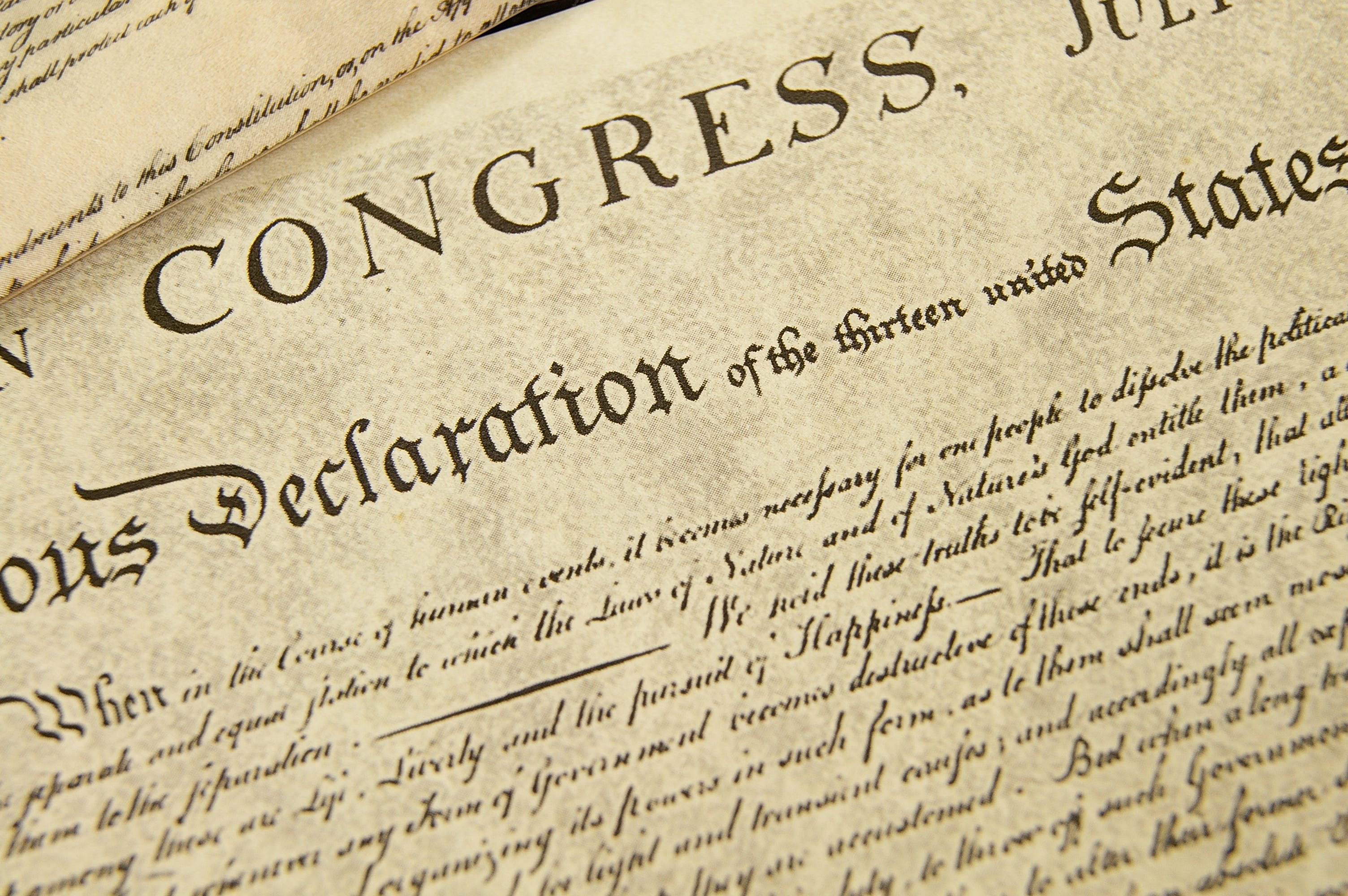
The Declaration of Independence is more than just a mission statement. It is a moral statement that begins with ideas about truth, freedom, and human dignity. It says there are “self‑evident truths” about people, based on “the laws of nature and of nature’s God,” that apply to everyone, both leaders and citizens. These truths do not come from Congress or kings. They exist before any government and judge every political system, including ours.
About 150 years later, John Paul II wrote an encyclical with a similar message: moral truth is real, we can know it, and true freedom comes from following that truth. Veritatis Splendor (The Splendor of Truth) is not a political text, but its main point—that “only the freedom which submits to the truth leads the human person to his true good”—matters for any country built on the idea of rights given by a Creator. In this way, it connects to the same moral foundations as the Declaration.
This belief—that freedom depends on moral truth—can be found in the words of Abraham Lincoln, Martin Luther King Jr., and Ronald Reagan. Each of them, in their own way, reminds the nation of the promises in the Declaration. They are closer to John Paul II’s view of moral truth than to today’s idea that truth is just a personal choice.
The Declaration as Moral Charter
Often, we repeat the Declaration’s most famous sentence almost like a ritual, without really thinking about what it means:
“We hold these truths to be self-evident, that all men are created equal, that they are endowed by their Creator with certain unalienable Rights… That to secure these rights, Governments are instituted among Men, deriving their just powers from the consent of the governed…”
This is more than just words; it is a statement about moral reality. The Declaration presents equality, rights, and limits on government as facts about human nature, not just hopes or social ideas. Jefferson says rights are “unalienable” because they come from a Creator, and governments exist “to secure these rights,” not to create them.
This is the idea behind natural law. There is a moral order in the world—“the laws of nature and of nature’s God”—that we do not create but discover. Man-made laws are valid only if they match this deeper order. If they do not, the Declaration says people can resist them.
No matter what else you think about 1776, this is not an example of relativism.
Veritatis Splendor: Freedom Under Truth
Veritatis Splendor opens with a line that fits well with the Declaration’s preamble: “The splendor of truth shines forth in all the works of the Creator and, in a special way, in man, created in the image and likeness of God.” For John Paul II, the main questions concern morals and human nature: Can people know what is good, and what happens to freedom if we deny that a moral law exists?
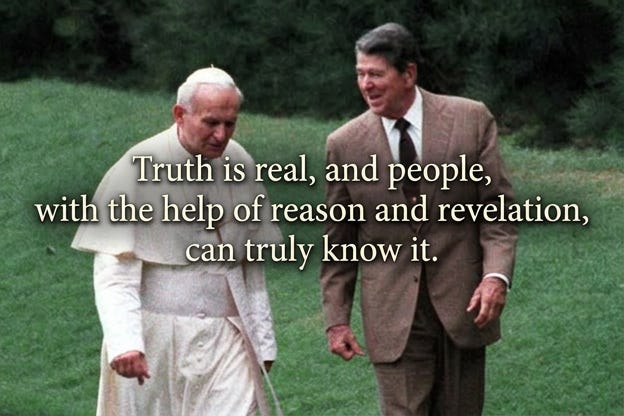
The encyclical gives a clear answer. Truth is real, and people, with the help of reason and revelation, can truly know it. Freedom is not just doing whatever we want, but being able to choose what is good and true. As it says, “only the freedom which submits to the truth leads the human person to his true good.” If freedom is separated from truth, it turns into a license to do whatever we want, which can lead to a new kind of slavery.
Crucially, Veritatis Splendor insists that some acts are “intrinsically evil”—always and everywhere incompatible with human dignity—regardless of intentions or circumstances. It rejects moral theories that reduce ethics to balancing outcomes or maximizing usefulness, and it defends conscience as the servant of truth rather than its creator. When we judge slavery, segregation, or totalitarian repression as wrong—not simply illegal, but wrong—we are presupposing this moral order.
In other words, when we say some things can never be justified, no matter how strongly we feel, we are thinking like the writers of the Declaration and like John Paul II, not like today’s ethical relativists. This is the encyclical's main point: moral truth is the standard for freedom, law, and politics. The same idea appears in the next part of Veritatis Splendor.
“Patterned on God’s freedom, man’s freedom is not negated by his obedience to the divine law; indeed, only through this obedience does it abide in the truth and conform to human dignity. Man achieves such dignity when he frees himself from all subservience to his feelings, and in a free choice of the good, pursues his own end by effectively and assiduously marshalling the appropriate means.”
In another important passage, John Paul II says that as people move toward God, they must freely choose good and avoid evil. This decision, he says, “takes place above all thanks to the light of natural reason,” which reflects God’s image. He bases natural law not on animal instincts, but on human reason, which shares in and reflects God’s law. This supports the idea that truth can be known.
Lincoln: Renewing the Vows
Abraham Lincoln understood these ideas naturally. To him, the Declaration was “the father of all moral principle” in American life, not just a piece of history. He saw the statement that “all men are created equal” as a core belief the nation was built on, and he viewed the Civil War as a test of whether a country based on that belief could survive.
The Gettysburg Address distills this logic with startling economy:
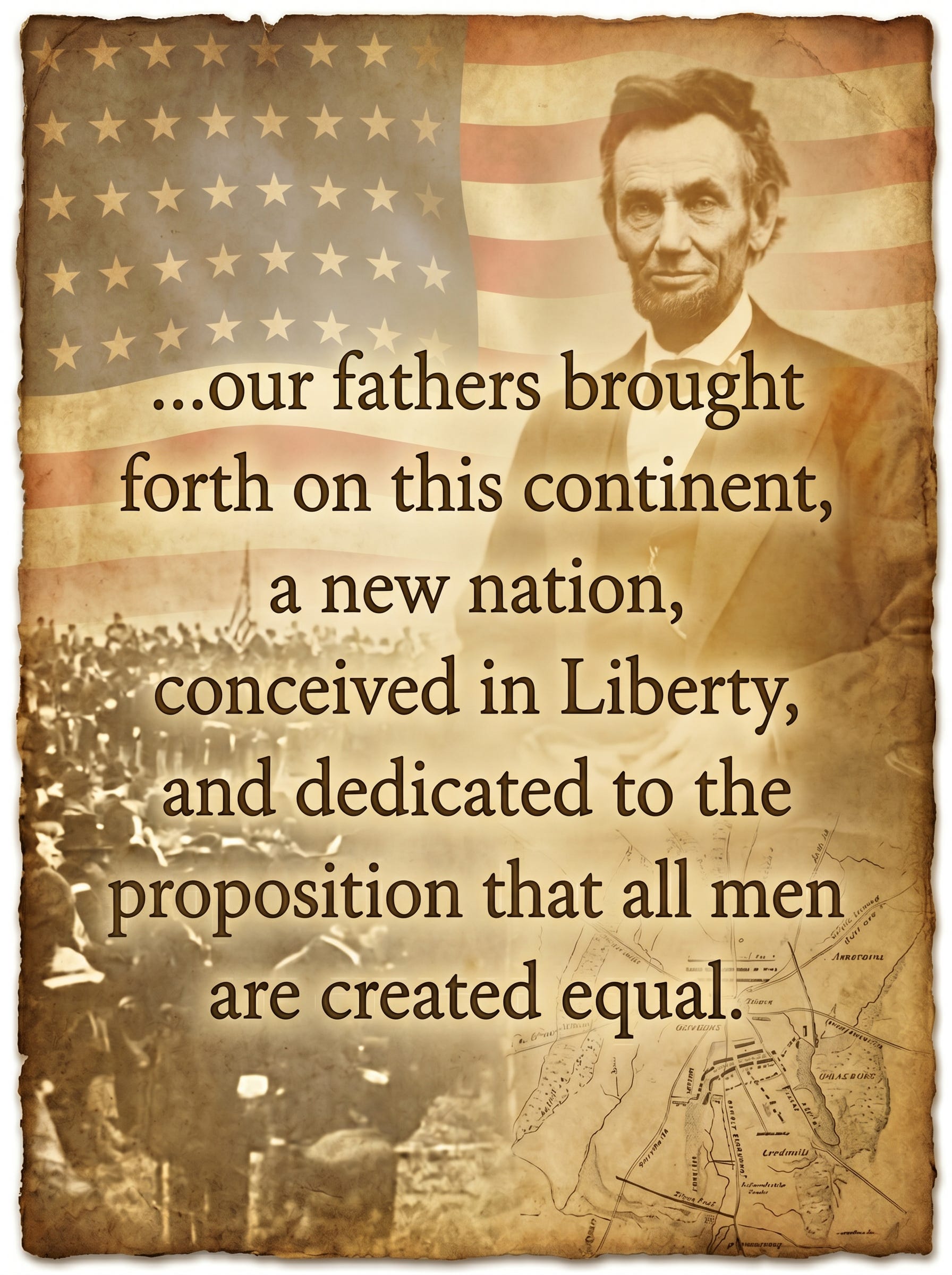
“Four score and seven years ago our fathers brought forth on this continent, a new nation, conceived in Liberty, and dedicated to the proposition that all men are created equal. Now we are engaged in a great civil war, testing whether that nation, or any nation so conceived and so dedicated, can long endure…”
“…that this nation, under God, shall have a new birth of freedom -- and that government of the people, by the people, for the people, shall not perish from the earth.”
Lincoln knew the Founders had made compromises with slavery. Still, he did not see the equality clause as meaningless. He saw it as a moral standard—“a stumbling block” for tyrants and “a constant rebuke” to injustice—that required each generation to get closer to its true meaning. At times, he warned that Americans could easily lose sight of this standard:
“As a nation, we began by declaring that ‘all men are created equal.’ We now practically read it ‘all men are created equal, except negroes.’ When the Know-Nothings get control, it will read ‘all men are created equal, except negroes, and foreigners, and Catholics.’ When it comes to this I should prefer emigrating to some country where they make no pretense of loving liberty – to Russia, for instance, where despotism can be taken pure, and without the base alloy of hypocrisy.”
Again, the connection to Veritatis Splendor is clear. Slavery is not just another policy preference; it violates the natural-law idea that all people are created equal and, consequently, is always unjust. In his Second Inaugural, Lincoln saw the war as a kind of divine judgment and called the nation to “firmness in the right as God gives us to see the right.” This was his way of thinking about what it means for a nation to live by moral truth.
King: Natural Law in Birmingham
A hundred years later, Martin Luther King Jr. viewed the Declaration through the lenses of Augustine and Aquinas. In his Letter from Birmingham Jail, King gives Americans perhaps the clearest explanation of natural law they will ever read.
“There are two types of laws: just and unjust. I would be the first to advocate obeying just laws… Conversely, one has a moral responsibility to disobey unjust laws. I would agree with St. Augustine that ‘an unjust law is no law at all.’
A just law is a man‑made code that squares with the moral law or the law of God. An unjust law is a code that is out of harmony with the moral law… To put it in the terms of St. Thomas Aquinas: An unjust law is a human law that is not rooted in eternal law and natural law. Any law that uplifts human personality is just. Any law that degrades human personality is unjust.”
For King, segregation laws are unjust because they harm human dignity and go against the equality promised in the Declaration. A law that does not match eternal law does not have real authority. Civil disobedience, then, is not lawlessness but loyalty—to a higher law, to conscience, and to the “promissory note” of 1776.
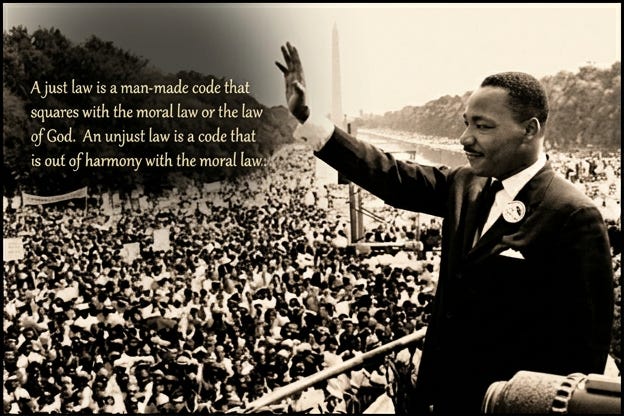
King’s argument closely matches the moral ideas in Veritatis Splendor: a well-formed conscience judges human law by objective moral truth; not every law from the state is binding in conscience; and some governing systems are always unjust. When King says he stands with the prophets, he is also, whether he says it or not, standing with natural-law reasoning.
Reagan and John Paul II: Moral Realism against the “Evil Empire”
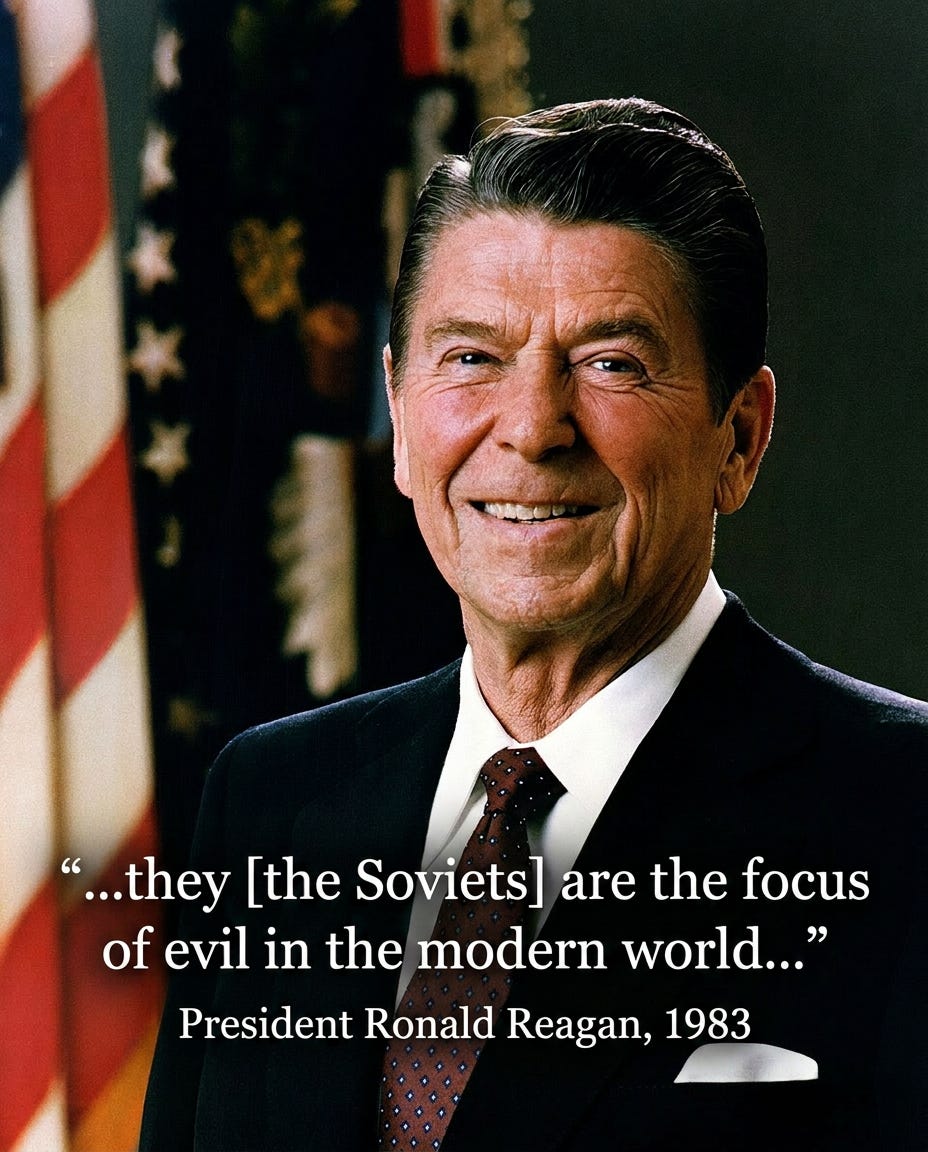
Ronald Reagan is often remembered for his optimism and his sense of the American story. But in his most controversial speech, given to the National Association of Evangelicals in 1983, he did something unusual for the time: he called the Soviet Union an “evil empire” and “the focus of evil in the modern world.” Like earlier leaders, this language assumes there is such a thing as moral truth.
“Yes, let us pray for the salvation of all of those who live in that totalitarian darkness—pray they will discover the joy of knowing God. But until they do, let us be aware that while they preach the supremacy of the State… they are the focus of evil in the modern world…
I urge you to beware the temptation of pride—the temptation of blithely declaring yourselves above it all and label both sides equally at fault, to ignore the facts of history and the aggressive impulses of an evil empire… and thereby remove yourself from the struggle between right and wrong and good and evil.”
Reagan did not see the Cold War as just a political struggle. He described it as a moral conflict about what it means to be human and where rights come from. He reminded people that rights do not come from the government but from God, and that governments exist to protect these rights, not give them as gifts. A government that crushes conscience, worship, and speech is not just different; it is, as Veritatis Splendor would say, built on lies about people.
John Paul II had lived under both Nazism and communism, and he saw where those lies lead. Veritatis Splendor’s warning about an “alliance between democracy and ethical relativism” is similar to Reagan’s admonitions against those who would excuse or normalize totalitarianism in the name of détente. When the two men converged in the 1980s, their partnership was far more than geopolitical strategy; it was the meeting of two moral realists who believed, stubbornly, that good and evil are not empty words.
A Common Thread and a Question
The Declaration says there are self-evident truths about human nature and rights, based on a Creator and binding on governments. Veritatis Splendor says that moral truth is real, that people can know it, and that freedom is found by following that truth. Lincoln, King, and Reagan, each in their own time and way, call America back to these truths: Lincoln with a “new birth of freedom,” King by showing the difference between just and unjust laws, and Reagan by naming evil and saying rights come before the state.
The hard question is what happens if we stop believing these things. What happens to a country built on “self-evident truths” if we treat truth as just a personal choice? What happens to conscience if we see all moral claims as just struggles for power? And what happens to freedom if it forgets the truth that once gave it meaning?
We can already see in some parts of Europe what happens when current ethical trends replace the unalienable right to free speech. Suddenly, speech that is unpopular or just uncomfortable becomes a crime, punished by the government. Why? Because in those places, what you can say depends on what those in power allow.
These are the questions that Lincoln, King, Reagan, and John Paul II would ask us. Are the truths of the Declaration still self-evident to us, or have we lost the meaning of what it means to be an American?
Well said Mark. It is so simple. It is remarkable how many "representatives" swear an oath to uphold and defend have either never read, don't comprehend or just outright lie. @kellyjohnston Tim Kane slipped an said his party's quiet policy outloud.
Best Independence Day essay I've ever read. And you ask the right question: "The hard question is what happens if we stop believing these things. What happens to a country built on 'self-evident truths' if we treat truth as just a personal choice? What happens to conscience if we see all moral claims as just struggles for power? And what happens to freedom if it forgets the truth that once gave it meaning?" We get U.S. senators and Vice Presidential nominees like Sen. Tim Kaine (D-VA), who infamously said, very recently, that our rights don't come from God, but government. That should be a wake-up call for all Americans. https://youtu.be/q9TdObFukZc?si=Iw3kYBXzhp38XEJZ